How to Create a Travel Guide: A Step-by-Step Guide
Creating a travel guide isn't just about listing places to visit. Today's travellers save recommendations everywhere: Google Maps, Instagram, TikTok, browser bookmarks, screenshots, travel blogs, emails, and messaging apps. By the time the trip begins, finding the right information can be almost as challenging as planning the trip itself.
A great travel guide solves this problem.
Rather than storing information across multiple apps and documents, it brings everything together into one easy-to-use, structured resource for before and during a trip.
Whether you're planning your own holiday, creating guides for clients, sharing local recommendations with guests, or creating travel content for your audience, the process is remarkably similar.
This guide will walk you through every step, from your initial idea to creating a finished travel guide that people will genuinely enjoy using.
The Anatomy of a Great Travel Guide
Before we dive into the process, it's helpful to understand what makes a travel guide truly valuable.
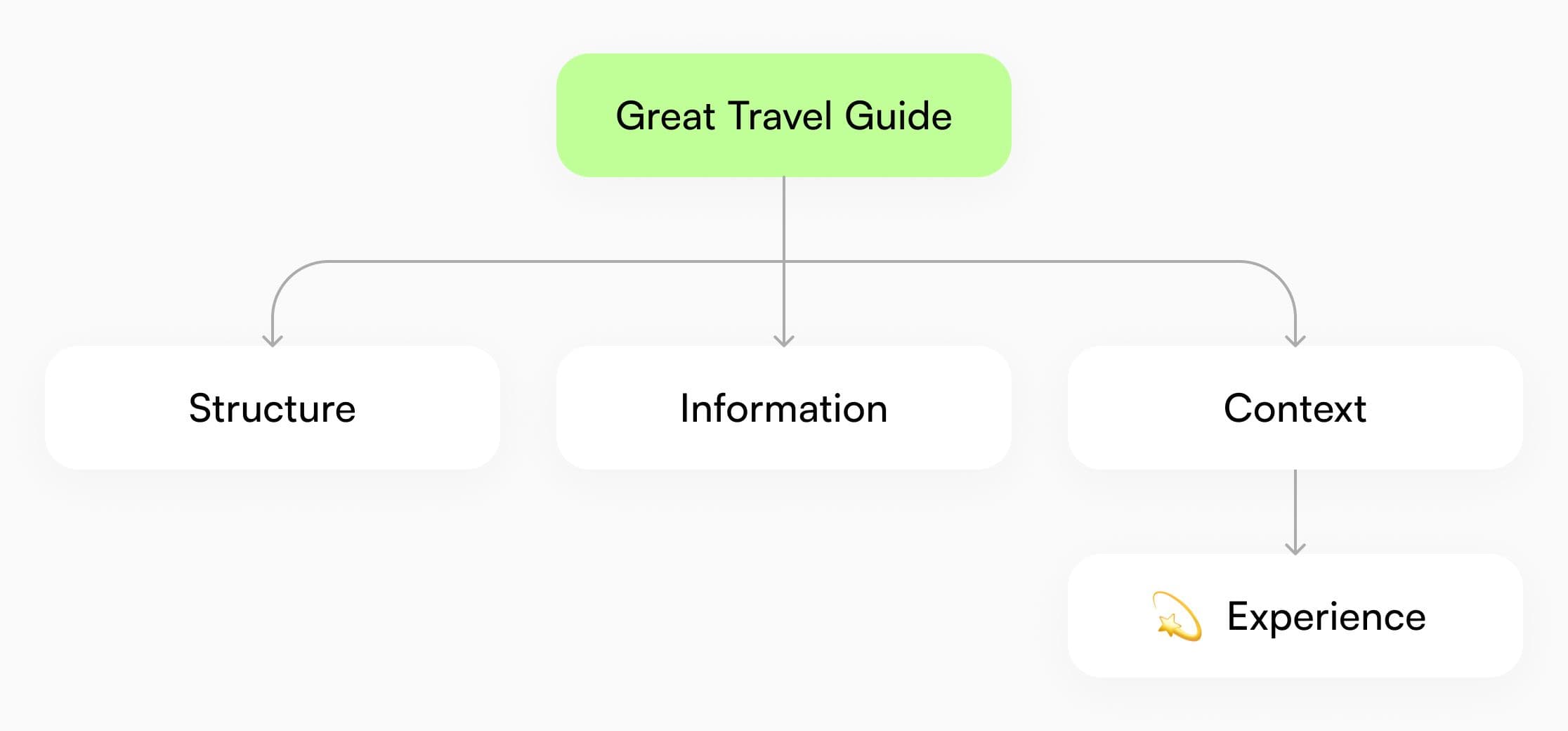
Many people assume that a guide is simply a list of places to visit. In reality, however, successful travel guides are built on four essential layers.
Without one of these layers, the guide quickly becomes incomplete or difficult to use.
Layer 1 — Structure
A great guide begins with organization.
Who is it for?
What problem does it solve?
How is the information grouped?
Without a clear structure, even the best recommendations can be difficult to navigate.
Layer 2 — Information
- This is the content of the guide itself.
- Locations.
- Maps.
- Routes.
- Restaurants.
- Transportation.
- Bookings.
Layer 3 — Context
This is what sets an ordinary guide apart from an exceptional one.
Instead of simply saying where to go, explain:
- why it's worth visiting;
- when to go;
- what to order;
- what to expect;
- who will enjoy it most;
- what alternatives exist.
Information tells people where.
Context helps them decide why.
Layer 4 — Experience
Finally, think beyond creating the guide.
Can people easily navigate it?
Can they open it on their phone?
Can it be updated?
Can it be shared?
Can it still be useful six months from now?
The best travel guides are designed to be used as well as read.
💡 Key takeaway
A travel guide is more than just a document.
It's a structured experience that provides travellers with the information, context and practical knowledge they need to make better decisions.
Step 1. Decide Who Your Travel Guide Is For
One of the biggest mistakes people make is starting with the destinations. Instead, start with your audience.
The same destination can produce completely different guides, depending on who will use them.
For instance, a guide for first-time visitors to Rome would look very different from one created for food lovers, families with children, or digital nomads.
Before collecting recommendations, complete one simple sentence:
This guide is created for...
Once you know who your audience is, every other decision becomes much easier.
Some of the most common audiences include:
💡 Pro Tip
The more specific your target audience, the easier it is to decide what information to include in your guide.
Step 2. Define the Purpose of Your Guide
Now that you know who your guide is aimed at, decide what you want it to achieve.
Not every travel guide needs to cover a whole destination.
In fact, many of the best guides focus on solving one specific problem.
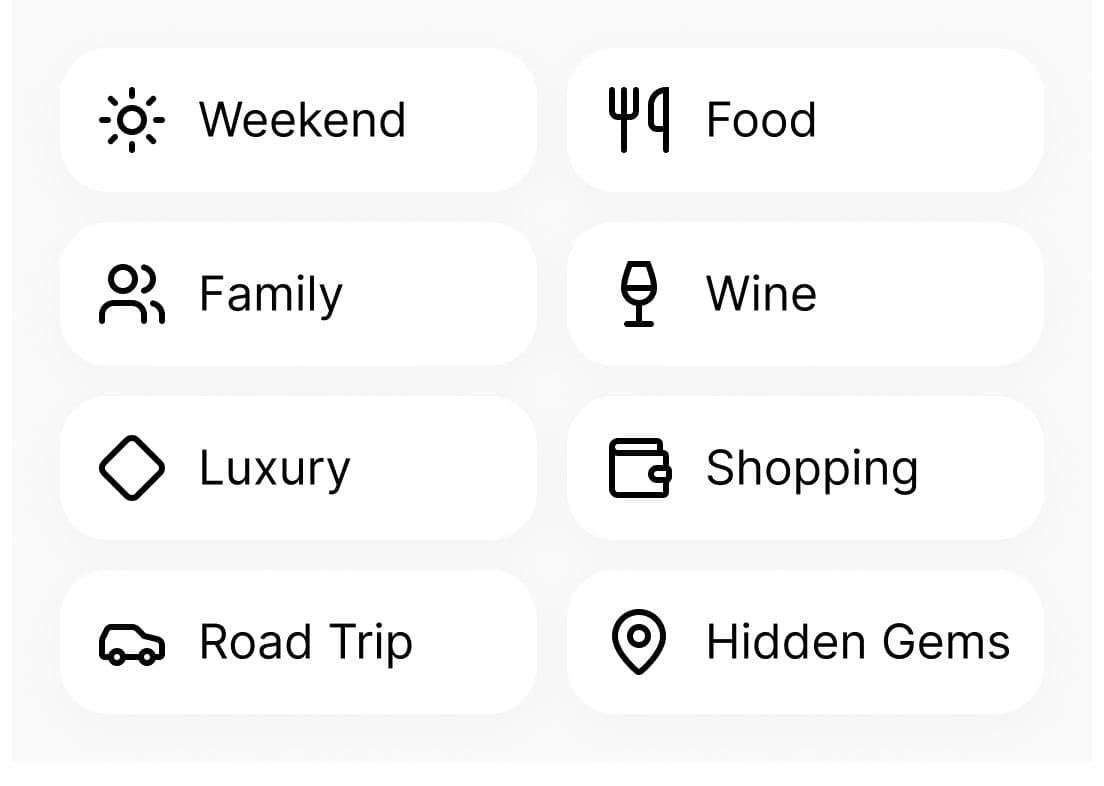
Examples include:
- A weekend city guide
- A food guide
- A wine guide
- A family travel guide
- A road trip guide
- A shopping guide
- A digital nomad guide
Including too much information can make a guide less useful.
Instead, ask yourself:
- What should readers be able to do after using this guide?
- What experience am I helping them create?
- What information can they find here that they won't easily find elsewhere?
Having a clear purpose helps you decide what to include and what to leave out.
⚠️ Common Mistake
The aim is to create the ultimate guide to a destination.
Readers usually find a focused guide more helpful than an overwhelming collection of recommendations.
Step 3. Collect Everything Before You Start Writing
Resist the temptation to start writing straight away.
First, gather together all the information you have already saved.
You may be surprised by how much travel information you have collected over time.
Look through:
- Google Maps
- Instagram Saves
- TikTok
- Notes
- Voice notes
- Emails
- Browser bookmarks
Don't worry about organising anything yet.
At this stage, it's simply a case of collecting your ideas in one place.
Once you can see everything, you'll naturally start to notice patterns, duplicate recommendations and missing information.
Only then should you start creating your guide.

Step 4. Organize Your Information
Once you have gathered all your content, it's time to organise it. There isn't one perfect structure. The most suitable format depends on your audience and how they will use the guide. Below are some of the most effective ways to organise your content.
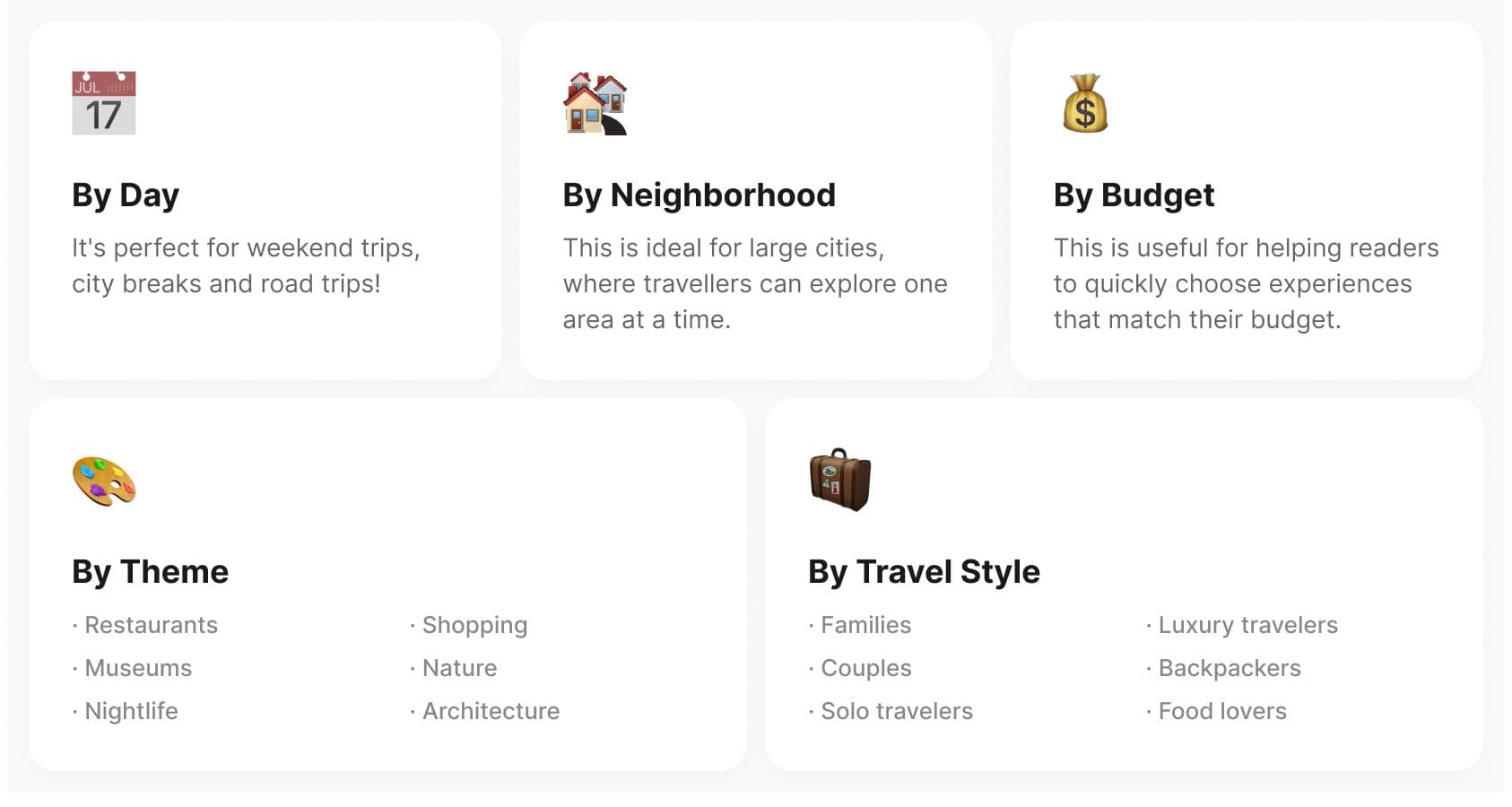
Remember that people don't judge a travel guide based on how many recommendations it contains. They judge it on how quickly they can find the information they need.
💡 Pro Tip
If your guide is so complicated that people are spending several minutes just navigating it, then you need to simplify the structure before adding more recommendations.
Step 5. What Should Every Travel Guide Include?
By this point, you should have defined your audience, clarified the purpose of your guide, and organised your ideas.
Now it's time to answer one of the most common questions:
What should a travel guide include?
There is no one-size-fits-all template for every destination or traveller. However, the most useful travel guides all have one thing in common: they provide practical information alongside enough context to help people make informed decisions.
Consider your guide to be more than just a list of recommendations.
It should provide answers to the questions that travellers naturally ask during their trip.
A Clear Structure
Every guide needs a logical framework. Before readers decide where to go, they need to understand how to use your guide.
Depending on its purpose, your content might be organized:
- by day;
- by neighborhood;
- by category;
- by travel style;
- by budget.
The right structure reduces the time people spend searching for information, allowing them to enjoy their trip for longer.
A Logical Itinerary
Even if your guide doesn't follow a day-by-day schedule, readers will still benefit from a logical structure.
Rather than recommending attractions randomly across a city, consider how someone would naturally explore the destination.
Group nearby locations together. Avoid unnecessary travel between neighbourhoods. Suggest realistic combinations of activities. The goal isn't to create a strict timetable. It's to help people move through a destination more naturally.
Maps and Locations
All recommendations should be easy to find.
Adding maps or location links allows travelers to:
- understand distances;
- compare nearby attractions;
- build efficient routes;
- avoid unnecessary backtracking.
Finding information shouldn't be an additional task while travelling.
Recommendations With Context
This is where most travel guides start to stand out from simple lists of places to visit. After all, anyone can recommend a restaurant. A great guide explains why that recommendation matters.
Whenever possible, answer questions like:
- Why should someone visit?
- Who is this place best suited for?
- What makes it special?
- How much time should visitors spend here?
- Is it worth planning in advance?
Providing context helps readers to make better decisions than simply collecting more locations.
Local Tips and Insights
Some of the most valuable travel advice doesn't appear on maps. These are the small details that only come from personal experience.
For example:
- the best time to visit;
- the best table to request;
- which entrance to use;
- what to order;
- how to avoid crowds;
- nearby alternatives;
- common mistakes first-time visitors make.
These practical insights often become the part of the guide that travelers remember most.
Practical Information
Recommendations are significantly more useful when they address practical issues. Whenever possible, include:
- opening hours;
- reservation requirements;
- transportation options;
- estimated costs;
- accessibility information;
- useful contact details.
It is often the small details like these that save travellers more time than dozens of additional recommendations.
Useful Resources
Finally, compile a list of everything that readers might need during their trip. For example:
- official websites;
- booking links;
- public transport resources;
- emergency contacts;
- offline maps;
- useful travel apps.
A guide is much more valuable if travellers don't need to switch between multiple apps to find the information they need.
What Every Great Travel Guide Should Include
✔ Clear structure
✔ Logical itinerary
✔ Maps and locations
✔ Recommendations with context
✔ Local tips and insights
✔ Practical travel information
✔ Transportation details
✔ Booking links
✔ Estimated costs
✔ Alternative recommendations
Step 6. Add Context, Not Just Places
Many people believe that travel guides improve with more recommendations. In reality, however, the opposite is often true. The value of a guide isn't determined by how many places it contains. It's measured by how many decisions it helps travellers make. Look at the example below.
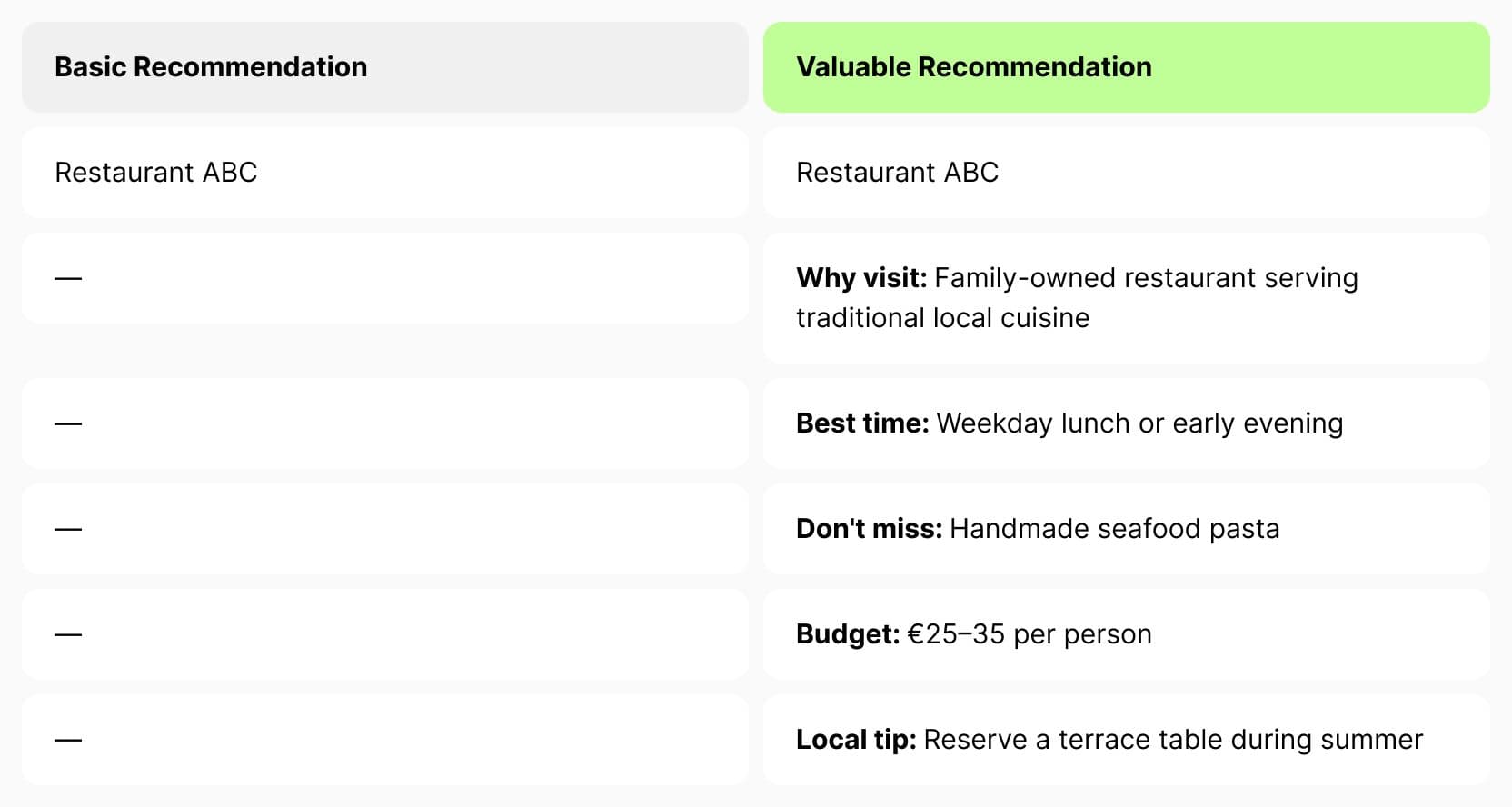
The restaurant itself hasn't changed. What has changed is the recommendation. It's this transformation that turns a collection of places into a travel guide. Whenever you recommend a location, try answering a few simple questions:
- Why is it worth visiting?
- What makes it different?
- Who will enjoy it most?
- How much time should people spend there?
- Is it necessary to book in advance?
- Are there similar places nearby?
These details help to reduce uncertainty and enable travellers to make better decisions. Often, one thoughtful recommendation is more valuable than five additional locations.
💡 Expert Insight
Information tells people where to go. Context helps them decide why. That's what sets a saved location apart from a memorable travel guide.
The goal isn't to recommend more places. It's to help travellers choose the right ones.
Step 7. Choose the Best Format for Your Travel Guide
Once your content is ready, the next step is to decide how you will present it. There are many different ways to create a travel guide today. Each format has its own advantages and limitations.
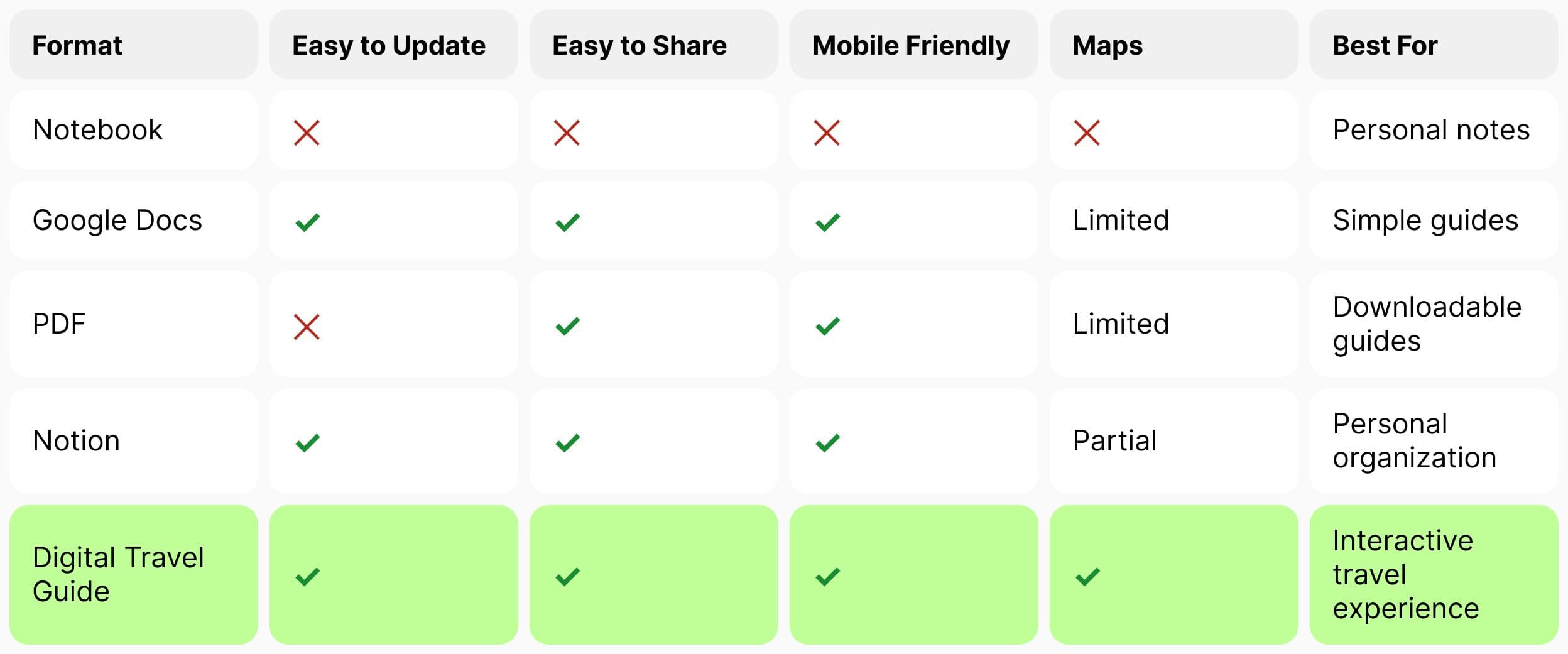
There is no one perfect format for everyone. The best choice depends on:
- who your audience is;
- how often you update your guide;
- how people will access it;
- whether the guide is intended for personal use or for sharing with others.
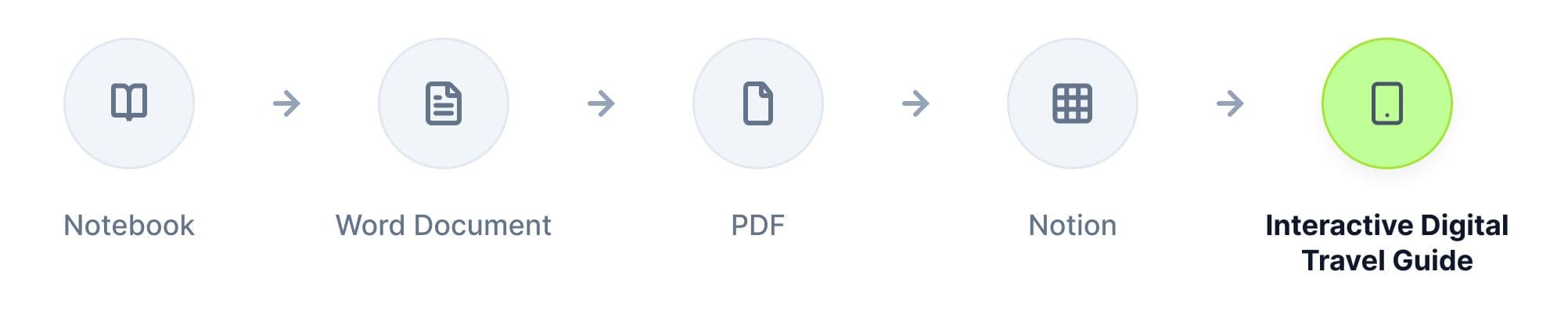
For occasional trips, a simple document may suffice. However, for guides that will be updated, reused or shared regularly, interactive digital formats are usually much easier to maintain.
💡 Pro Tip
Choose a format that makes your guide easy to use, rather than one that looks impressive. A simple guide that people actually use is far more valuable than a beautifully designed one that sits gathering dust on a shelf.
Step 8. Make Your Guide Easy to Share
Creating a great travel guide is only half the job. The other half is ensuring that people can actually use it. Consider how your audience will access your guide. Will they read it on a phone while walking through a city? Will they open it before a trip? Will they come back to it several times during their journey?
The easier your guide is to access and navigate, the more likely people are to use it.
A good travel guide should be:
- easy to open on any device;
- simple to navigate;
- quick to scan;
- easy to share;
- available whenever travelers need it.
Remember that convenience is an important part of the experience. Even the best recommendations are worthless if people can't find them.

💡 Pro Tip
Before publishing your guide, open it on your phone and see if you can find one specific recommendation in under ten seconds. If it takes you longer than that, simplify the navigation.
Step 9. Keep Your Guide Updated
Travel information is constantly changing.
Restaurants close.
Museums change their opening hours.
Public transport routes are updated.
New places become local favourites.
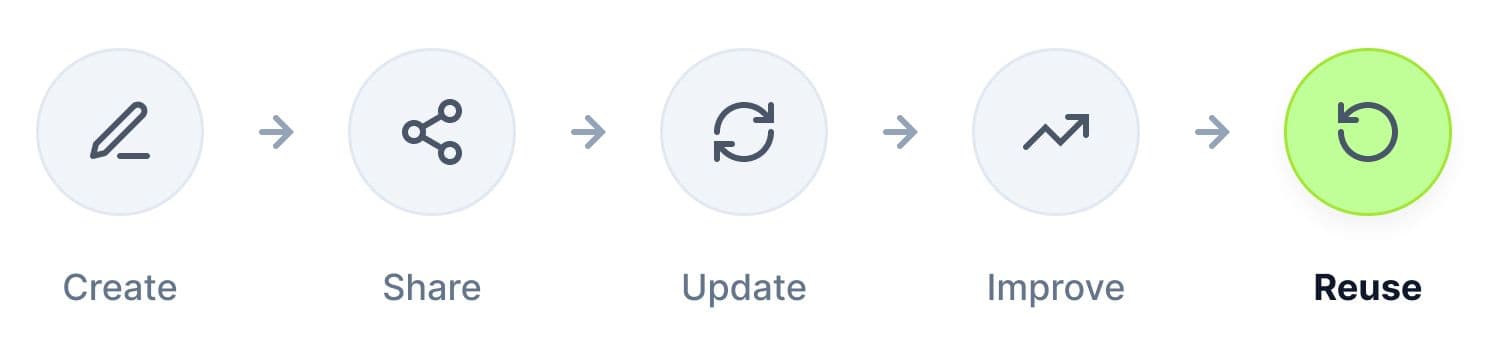
This is why the best travel guides are never truly finished. Instead of treating your guide as a one-off project, think of it as a living resource that evolves over time. After every trip, ask yourself:
- Which recommendations were still accurate?
- What surprised you?
- Which places deserve to be added?
- What information has become outdated?
Although small updates only take a few minutes, they can keep your guide relevant for months or even years.
💡 Pro Tip
Rather than creating a new guide for each trip, focus on improving the ones you've already made.
They will become significantly more valuable over time.
Step 10. Can You Sell a Travel Guide?
Many people create travel guides for personal use.
Others realise that this knowledge can be turned into a valuable digital product.
If your guide contains original recommendations, practical advice, and local insights, it can continue to help people long after your trip has ended.
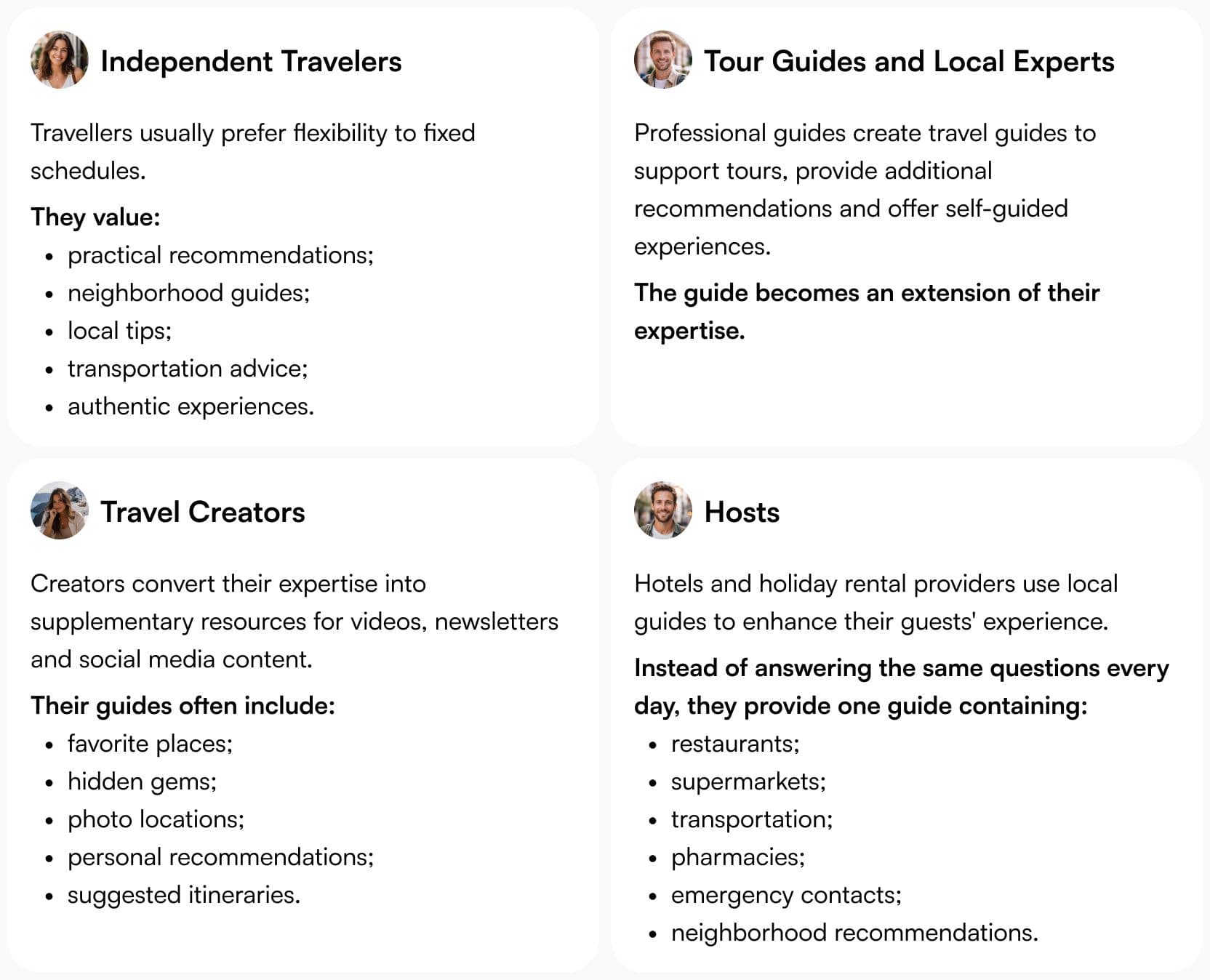
Nowadays, travel guides are created and shared by all kinds of people.
Travel Creators
Creators transform their experiences into downloadable resources to complement their videos, newsletters, and social media content.
Tour Guides
Professional guides use travel guides both before and after tours to provide self-guided experiences and create additional resources for clients.
Hosts
Hotels and short-term rental hosts can enhance the guest experience by anticipating and answering common questions before guests even have the opportunity to ask them.
Local Experts
People with in-depth local knowledge compile years of recommendations into guides that others can use time and again.
Whether or not you decide to charge for your guide, the process of creating one adds long-term value.
Once your knowledge is organised, it becomes a valuable asset that can be updated, reused and shared indefinitely.
💡 Remember
Great travel guides don't just help people discover more places. They help people to make better travel decisions.
Common Mistakes When Creating a Travel Guide
Even experienced travellers make mistakes. Fortunately, most of these mistakes are easy to avoid.
Trying to Include Everything
The aim isn't to list every attraction in a destination. Instead, curate recommendations that best match your audience.
Forgetting Who the Guide Is For
A guide that is intended to be useful to everyone is usually not useful to anyone. Always keep your audience in mind.
Listing Places Without Context
Recommendations only become valuable when readers understand why the places you recommend are worth visiting.
Always explain your reasoning.
Ignoring Practical Information
Information on opening hours, reservations, transport links and estimated costs is often just as important as the recommendation itself.
Never Updating the Guide
Travel guides quickly become outdated. Review your content regularly and remove any inaccurate information.
Frequently Asked Questions
How do I create a travel guide?
First, define your audience and the purpose of your guide. Next, collect your ideas, organise your information, add context, and select an easy-to-share and updateable format.
What should a travel guide include?
A complete travel guide typically includes an itinerary, maps, recommendations, local insights, practical information, transport details, and useful links.
What is the best format for a travel guide?
The most suitable format depends on how your guide will be used. Generally, interactive digital travel guides are easier to update, share and access across multiple devices than traditional documents or PDFs.
Can I sell a travel guide?
Yes. Many travel creators, guides, hosts and local experts produce valuable digital travel guides.
How long should a travel guide be?
There is no such thing as the perfect length. A guide should provide readers with enough information to help them achieve their goal, without overwhelming them with unnecessary details. Quality is always more important than quantity.
Conclusion
Creating a travel guide isn't just about collecting as many recommendations as possible. It's about organising information in a way that helps others to travel with more confidence.
The same principle always applies, whether you're creating a guide for yourself, your clients, guests or audience.
Every recommendation should answer one simple question: Will this help someone make a better travel decision?
If the answer is yes, then your guide is already doing everything that a great travel guide should do.
The best travel guides don't just tell people where to go. They help people understand why, when and how to experience a destination in the best possible way.
Ready to Turn Your Travel Ideas Into a Guide?
You already know what makes a great travel guide:
✓ A clear structure
✓ Practical information
✓ Local insights
✓ Helpful recommendations
Now it's time to create your own. Start with your notes, saved places and ideas, and let the Octripus AI Guide Generator help you turn them into a structured digital travel guide. → Create Your Guide