Travel Guide Template: What Every Guide Should Include

Are you planning to create a travel guide but not sure where to start?
Using a travel guide template provides a ready-made structure, so you don't have to start from scratch every time. Rather than wondering what information to include next, you can focus on populating each section with your own recommendations, local knowledge, and travel tips.
A consistent structure saves time and makes your guides easier to read, update and share, whether you're a travel creator, tour guide, blogger or local expert.
What Is a Travel Guide Template?
A travel guide template provides a predefined structure to help you organise information about a destination in a clear and consistent way.
Rather than starting from scratch every time, you can use the same framework and customise it with your own recommendations, tips and local knowledge.
While a travel itinerary focuses on the order of activities, a travel guide provides the additional context that helps travellers understand why a destination is worth visiting and how they can get the best experience.
A typical travel guide template can be used for different destinations while retaining the same professional structure. This makes it particularly useful for creators who regularly publish or sell travel guides and other digital travel products.
Why Use a Travel Guide Template?
Creating every guide from scratch can quickly become repetitive.
A well-designed template allows you to focus on your area of expertise rather than formatting documents each time you publish new content.
Using a consistent travel guide template enables you to:
- save hours of work on every new guide;
- maintain the same quality across all destinations;
- make your guides easier to navigate;
- update information without rebuilding the entire document;
- create guides that are easier to share or sell.
Many professional travel writers use templates because consistency benefits readers too. When every guide follows the same structure, users know exactly where to find practical information, recommendations, maps and local tips.

Rather than reinventing your workflow for each destination, you can create one structure and reuse it time and time again.
What Should Every Travel Guide Include?
Although there is no single 'correct' way to write a travel guide, the best ones usually contain the same core sections.
Think of your template as a framework. While you can always add or remove sections depending on your audience, these elements provide a solid starting point.
1. Introduction
Begin by explaining what makes this destination worth visiting.
Providing a brief introduction helps readers to understand what to expect before they read the details.
Include:
- what makes the destination unique;
- who it's best for;
- the best time to visit;
- how much time people should plan to spend there.
2. Recommended Itinerary
Organise the recommendations into a logical route.
Rather than listing places at random, show readers the most sensible order.
This could be:
- one-day itinerary;
- weekend itinerary;
- three-day city guide;
- neighbourhood-by-neighbourhood route.
Even a simple chronological structure makes a guide much easier to follow, which is why it is so important to ensure that all guides are structured in this way.
3. Places to Visit
This is usually the longest section of the guide.
For each recommendation, provide consistent information, such as:
- short description;
- why it's worth visiting;
- approximate visit duration;
- opening hours;
- ticket price (if applicable);
- Google Maps link;
- official website (if available).
The objective is not to write long descriptions; it is to provide readers with sufficient information to make informed decisions.
Looking for inspiration? Take a look at What Is a Digital Travel Guide? to see how modern interactive guides bring together locations, maps, tips and recommendations in one place.
4. Personal Recommendations
This is what sets your guide apart from the information people can already find on Google.
Share practical advice based on your own experience.
Examples include:
- the best viewpoint that most tourists miss;
- where locals actually eat;
- which attractions are worth skipping;
- the quietest time to visit;
- mistakes first-time visitors often make.
People usually choose your guide over a generic travel article because of your personal insights.
5. Practical Information
A good travel guide should also answer the small questions that travellers ask during their trip.
Consider including the following:
- how to get there;
- public transportation;
- parking information;
- accessibility;
- payment methods;
- estimated budget;
- internet availability;
- safety tips.
Providing these details reduces uncertainty and improves the overall travel experience.
6. Maps
Maps make recommendations much easier.
Where possible, include the following:
- Google Maps links;
- embedded maps;
- walking routes;
- grouped locations.
Visual navigation is particularly useful for city guides and self-guided walking tours.
7. Photos
Images help travellers to understand what to expect before they arrive.
Use original photos wherever possible.
Good images can show:
- the atmosphere;
- food;
- viewpoints;
- entrances;
- landmarks;
- hidden spots.
Real photographs are much more effective at building trust than stock images.
8. Local Tips
End each location section — or the guide itself — with practical advice that travellers won't easily find elsewhere.
For example:
- visit before 9 a.m. to avoid queues;
- book tickets several weeks in advance;
- bring cash;
- avoid weekends;
- order a specific local dish;
- use a particular entrance.
It is often the small recommendations that provide the greatest value.
Travel Guide Checklist
Before you publish your guide, make sure that you have included everything you need to
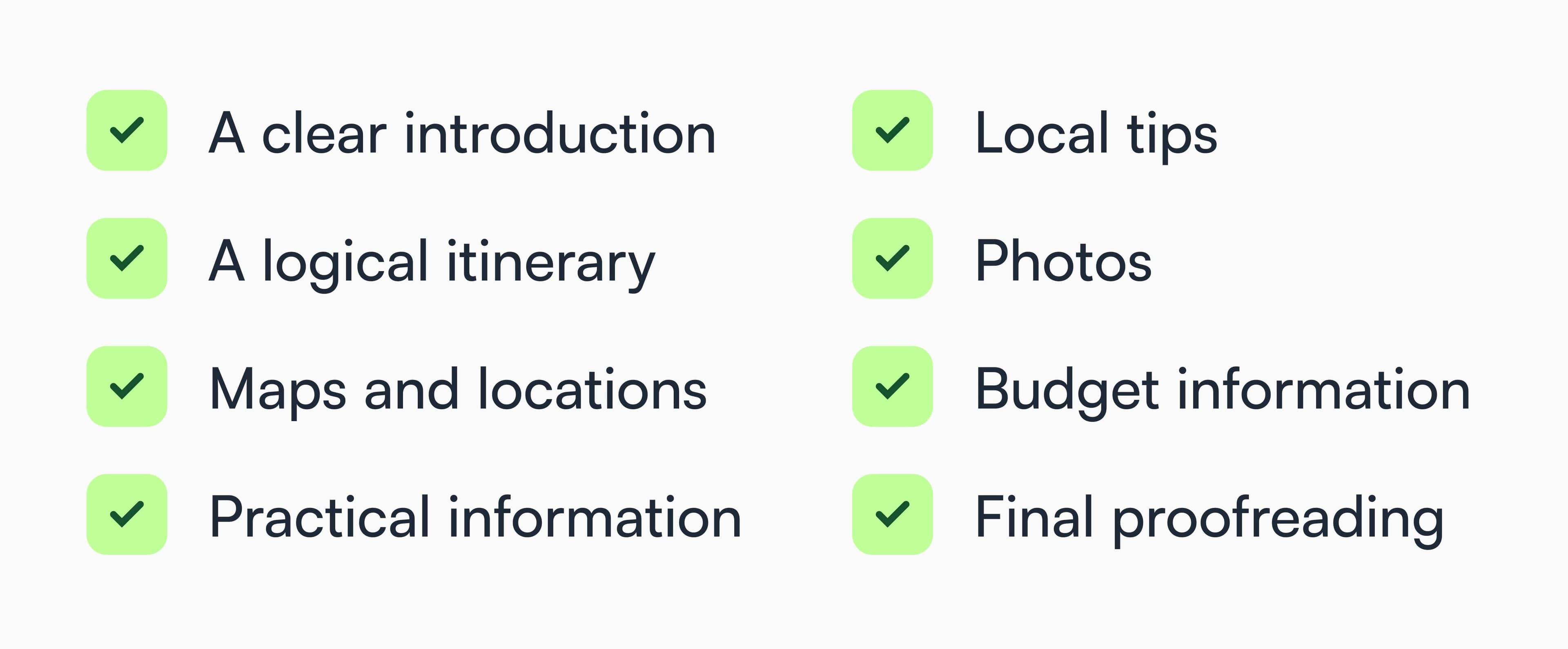
need to plan and enjoy their trip.
Travel Guide Structure
Although every destination is different, the most successful travel guides tend to follow a similar structure.
Consistently organising information makes your guide easier to read and update, and much more useful during the trip.
The following structure works for almost any destination
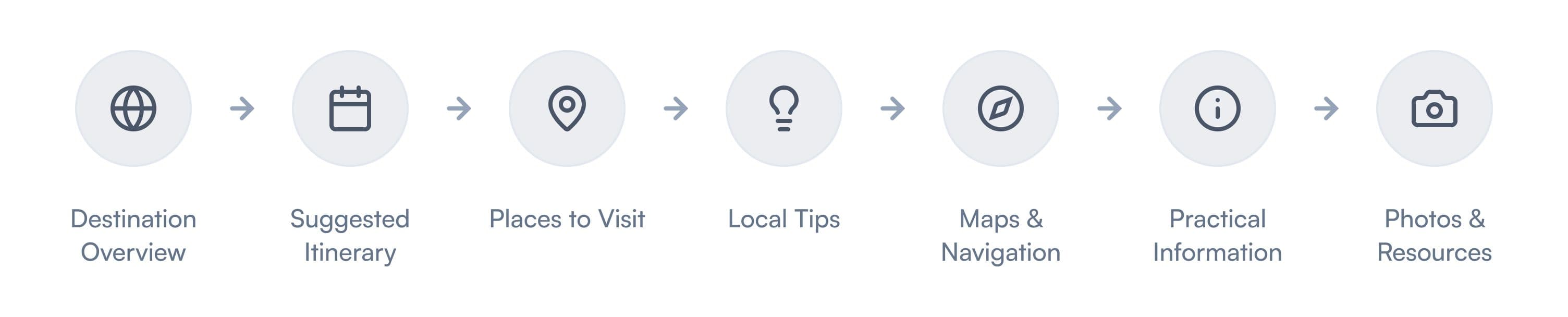
Notice how the guide progresses from general information to practical details.
First, readers understand where they are going; then, what to do; and finally, how to make the most of their visit.
This straightforward structure makes the guide easy to navigate and prevents it from becoming overwhelming.
Travel Guide Example
Once you have a clear structure, it is helpful to see how these elements come together in real travel guides.
A well-organised guide might include an itinerary, places to visit, personal recommendations, practical information, maps, and local tips. The exact content and structure will vary depending on the destination.
Explore our collection of interactive travel guides for different cities to see how travel information can be organised in practice.
Explore Travel Guide Examples →
This may also give you ideas on how to adapt the above structure to suit your own destination and audience.
Why This Structure Works
A well-structured travel guide is easier to read and creates a better travel experience.
When every recommendation follows the same format, travellers spend less time searching for information and more time enjoying their destination.
For creators, using a repeatable structure makes guides easier to maintain and update as recommendations change over time.
Rather than creating a new document for every destination, you can improve and reuse a single proven framework.
FAQ
What is a travel guide template?
A travel guide template is a reusable framework for organising travel information. Rather than starting from scratch each time, you can follow a consistent structure that incorporates recommendations, itineraries, maps, practical information and local tips.
What should a travel guide include?
A complete travel guide should include:
- an introduction to the destination;
- a suggested itinerary;
- recommended places to visit;
- personal recommendations;
- maps and navigation;
- practical information or local tips;
- photos.
While the exact structure may vary depending on the destination and audience, these sections form the basis of most successful travel guides.
What's the difference between a travel guide and a travel itinerary?
A travel itinerary is all about the when and where, while a travel guide tells you what to do, why it's worth a visit, and how to get the most out of it.
Many modern digital guides combine these two features in one resource.
Can I create a travel guide without design skills?
Yes. You don't need to be a designer to create a travel guide that looks professional. Using a structured template or a platform designed specifically for travel guides helps you to organise your content without having to worry about layout or formatting.
Can I reuse the same template for different destinations?
Absolutely. Most creators start with one template and adapt it for each new destination. This ensures consistency across all their guides and significantly reduces the time needed to create new content.
Conclusion
A travel guide template is much more than just a document; it's a repeatable system for transforming travel knowledge into something that is useful, organised and easy to share.
Following a consistent structure when creating guides for yourself, your clients, or your audience helps you produce clearer, more valuable, and more professional content every time.
The best travel guides don't just list places to visit. They combine practical information, personal recommendations, local insights, maps and itineraries to help travellers make better decisions and enjoy better experiences.
As digital travel guides become the new standard, a well-designed template makes it easier to create informative, engaging, and easy-to-navigate guides.
If you're ready to build your own interactive guide, start by establishing a clear structure, then add your personal expertise and let technology handle the presentation.
Create Your First Digital Travel Guide
Are you ready to transform your travel expertise into a professional digital guide?
Create your first interactive travel guide with Octripus, where you can organise maps, itineraries, local tips, photos and recommendations all in one place. 👉 Start for Free